When cat ready to attact...just see the style..ughh...roarr...

Funny Cats Video
Pussy Cat..upss :P I mean Funny Cats Video here it is....really funny..prepaired your self to laugh loud..hehe
New Movie !!! Harry Potter and the Half-Blood Prince
 Release Date: July 15, 2009 (conventional theaters and IMAX)
Studio: Warner Bros. Pictures
Director: David Yates
Screenwriter: Steven Kloves
Starring: Daniel Radcliffe, Rupert Grint, Emma Watson, Jim Broadbent, Helena Bonham Carter, Robbie Coltrane, Warwick Davis, Michael Gambon, Alan Rickman, Maggie Smith, Timothy Spall, David Thewlis, Julie Walters, David Bradley, Jessie Cave, Frank Dillane, Tom Felton, Matthew Lewis, Evanna Lynch, Helen McCrory, Natalia Tena, Hero Fiennes Tiffin, Bonnie Wright
Plot Summary: Voldemort is tightening his grip on both the Muggle and wizarding worlds and Hogwarts is no longer the safe haven it once was. Harry suspects that dangers may even lie within the castle, but Dumbledore is more intent upon preparing him for the final battle that he knows is fast approaching. Together they work to find the key to unlock Voldemort's defenses and, to this end, Dumbledore recruits his old friend and colleague, the well-connected and unsuspecting bon vivant Professor Horace Slughorn, whom he believes holds crucial information. Meanwhile, the students are under attack from a very different adversary as teenage hormones rage across the ramparts. Harry finds himself more and more drawn to Ginny, but so is Dean Thomas. And Lavender Brown has decided that Ron is the one for her, only she hadn’t counted on Romilda Vane's chocolates! And then there's Hermione, simpering with jealously but determined not to show her feelings. As romance blossoms, one student remains aloof. He is determined to make his mark, albeit a dark one. Love is in the air, but tragedy lies ahead and Hogwarts may never be the same again.
The Mystery of Mona Lisa's Smile
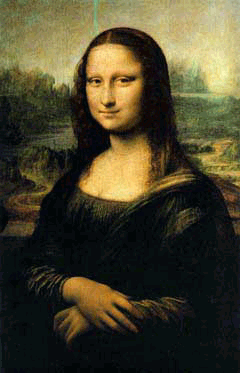 In case you haven't heard about Mona Lisa's mysterious smile, here's the story.
When you glance at this famous portrait of an unknown woman, you think you catch a flirtatious smile hovering on her lips. But when you take a better look, she's barely smiling at all!
The portrait was painted by Leonardo da Vinci about 500 years ago. It was originally called La Gioconda. This is thought to be the family name of the woman in the portrait, although no one is quite sure who the mystery woman is; the name Mona Lisa came later.
It's also said that once he'd finished painting it, da Vinci was even more captivated by the portrait than by the lady herself. Leonardo apparently took the portrait with him on his travels to Milan, Rome and France.
Now the Mona Lisa hangs in the Louvre art gallery in France. Every year the picture attracts millions of visitors who love to stand and ponder the lady's beguiling expression. Is she smiling at us or not?
Looks can be deceiving ...
And the answer is ... "kind of", says Dr Margaret Livingstone, a neuroscientist from Harvard Medical School. According to Margaret, when you glance at the portrait, your attention goes first to Mona Lisa's eyes. And while your eyes are glued on her eyes, you are seeing her mouth in your peripheral vision. Peripheral vision refers to the fact that you can see things that are not directly in front of you, but you can't see them very well. Things that are over to the side are detected by the edges of your retina, which is a less sensitive part of your eye.
The retina is the curved back surface of your eye that is sensitive to light; it's like the film in a camera. Things that are right in front of you are picked up by the centre of your retina, the fovea.
Optical illusion: how it works ...
Peripheral vision is not very good at seeing details but it is good at seeing black and white, shadows and movements, Because of the shadows around Mona Lisa's cheeks and in the corner of her mouth you get the impression that you can see the upturn of a smile.
Next, your eyes move to Mona Lisa's mouth. When you look at her mouth directly, the image forms on your fovea, which is the most sensitive part of your retina. The fovea is where you have good colour vision (there are lots of cells there that detect colour). However, this part of the retina does not register shadows well, so it barely registers the shadow on Mona Lisa's cheek and mouth. And, hey presto, you see her mouth as flat.
So there you go: now you see it, now you don't. And if you're wondering if da Vinci realised as he painted her smile what an intriguing effect he was creating, well rumour has it, he knew exactly what he was doing, even though it's taken scientists years to work it out!
By the way, if you're trying to see it for yourself, it helps if you zoom the picture up a fair bit, so that you can shift your gaze around the portrait.
Berry Billingsley-http://www.esscont.com/
Langganan:
Postingan (Atom)